

News, Stories and more
Our Blog
View BY :


Jacob Long's Nineteen Years of Roast Craft, Seasonal Sourcing, and the Soul of Artisan Coffee
June Feature | Roastmaster’s Select
There’s a particular fragrance that drifts through the roastery in the early morning before the harbor fully wakes up. Warm sugars beginning to caramelize. Citrus lifting from the drum. A fleeting note of cedar or cocoa carried out toward the Pacific fog.
For nearly two decades, that rhythm has belonged in part to Roastmaster Jacob Long.
This June marks Jacob’s 19th year at Thanksgiving Coffee Company, continuing a craft lineage that began with co-founder Paul Katzeff in the 1970s and stretches further still, through the farmers, cooperatives, and communities whose hands shape every harvest. What began in 2007 as an apprenticeship in artisan roasting has grown into one of the defining expressions of the Quarterly Roast Masters Select and the Roastmasters's Select Club: a living exploration of seasonality, processing innovation, and the ongoing craft of honest roasting.
At Thanksgiving Coffee, roasting is about relationship, calibration, curiosity, and honoring the potential hidden inside every green coffee seed.
And after more than fifty years of roasting coffee on the Mendocino Coast, with nineteen of them shaped alongside Jacob at the roaster, that sense of curiosity and care still moves through every batch that passes through the drum.
From Dark Roasts to Flavor Exploration
When Jacob entered the specialty coffee world in 2007, the industry was in the middle of a significant shift. Roasters were pushing toward lighter profiles, asking new questions about what coffee could taste like when the roast stepped back and let origin speak.
The conversation expanded quickly beyond country of origin into varietals, farmer lots, fermentation methods, and post-harvest experimentation. Processing techniques once rare or little known outside producing regions now shape some of the most sought-after coffees in the world.
Processing Method
1. Washed
2. Natural
3. Honey Process
4. Anaerobic Fermentation
Flavor Profile
1. Clean, bright, transparent acidity
2. Fruity, sweet, berry-forward
3. Syrupy body with layered sweetness
4. Wine-like complexity, tropical fruit, spice
Anaerobic coffees in particular have transformed modern specialty coffee. By fermenting coffee cherries in oxygen-free environments, producers can unlock deeply expressive flavor profiles unlike anything the industry experienced a generation ago: notes reminiscent of sangria, ripe mango, cacao nibs, or fermented berries.
For Jacob, this evolution opened the door to a new era of creativity. But it never changed the foundation.
“Paul really encouraged exploration. We already had a strong foundation and clear roasting parameters, but there was room to evolve, to seek out unique coffees and showcase what producers were truly capable of.”
That spirit helped shape Roastmaster’s Select, where seasonality, rarity, and craftsmanship take center stage.
June is also a time we recognize World Environment Day, and coffee reminds us how deeply flavor is connected to ecology. Altitude, rainfall, biodiversity, soil health, and careful stewardship all shape what ultimately arrives in the cup. Every harvest is a reflection of an ecosystem in consant motion.
“Paul really encouraged exploration. We already had a strong foundation and clear roasting parameters, but there was room to evolve, to seek out unique coffees and showcase what producers were truly capable of.” Jacob Long
Following the Harvest
Coffee is seasonal agriculture. Just as wine changes with vintage and climate, coffee moves through harvest cycles around the globe. One of the first things Jacob evaluates when selecting a coffee for Roastmaster’s Select is simple: is it the right moment for this bean?
Fresh crop coffees arrive with heightened aromatics, vivid acidity, and a clarity in the cup that slowly fades with time. Sourcing seasonally is not a preference. It is often the difference between a memorable coffee and a merely good one.
As Director of Coffee, Jacob works closely with trusted importers, cooperatives, and producers across many growing regions to source extraordinary coffees at peak freshness. His work combines sensory calibration, relationship-building, seasonal timing, and years of cupping experience to help shape each Roastmaster’s Select release.
This creates the opportunity to feature rare microlots, innovative processing methods, and seasonal offerings that many coffee drinkers rarely have the opportunity to experience.
As harvest seasons become less predictable and coffee communities adapt to new challenges, long-term relationships and shared knowledge have become essential to sustaining both exceptional coffee and the people who grow it.
Over the years, Roastmaster’s Select has featured coffees from:
-
Ethiopia:
Hafursa, Banko Dhadhato, Konga, Refisa
-
Nicaragua:
Finca Alexa, Finca Los Pinos, Carlos Lanzas, Reynaldo Mairena
-
Honduras:
COMSA Cooperative, Miriam Perez
-
Kenya:
Nyeri Othaya Ichamama
-
Peru:
COCLA Cooperative, Sol Y Café Cooperative, Finca Matapalo
-
Guatemala:
Los Jóvenes ASOBAGRI Cooperative, Finca Las Mercedes
-
Tanzania:
Zanzibar Peaberry
-
Malawi:
Mzuzu Cooperative
-
Indonesia:
Sulawesi, Sumatra, Flores, Java
-
Mexico:
Enjambre Cafetalero Cooperative
-
Ecuador:
FAPECAFES Cooperative
-
Bolivia:
Cooperativa Aljiri
-
Brazil:
COOPFAM Cooperative
-
El Salvador:
El Mural Pacamara
-
Laos
Jhai Cooperative
-
Colombia
Finca La Cabana, Finca Agroberlin, COSURCA Cooperative
-
Panama Geisha
Finca Lerida Geisha
-
Papua New Guinea
Nebilyer Valle
-
Costa Rica
Finca La Amistad
-
Yemen
Sharqi Haraz Cooperative
-
Uganda
Mirembe Kawomera Cooperative
-
Congo
SOPACDI Cooperative, Mukwinja Station
These coffees represent more than geography. They reflect distinct climates, elevations, varietals, processing innovations, and the evolving creativity of the people producing them.
Through the work of the Cupping Labs project, before “single farmer lots” became a marketing phrase across the industry, Thanksgiving Coffee initiated farmer-focused sourcing through it's Campesino campaign (2005), moving beyond broad regional designations to spotlight individual growers and cooperative communities by name.
That early work laid the foundation for Jacob to create what the Roastmaster’s Select is today: coffees chosen not simply for origin, but for the distinct personalities, processing styles, harvest conditions, and craftsmanship of the people behind them.
Roastmaster Jacob Long evaluating coffees in Thanksgiving Coffee’s cupping lab
The Craft Behind the Cup
Roasting coffee at this level requires constant calibration.
Jacob’s work extends far beyond standing beside the drum. Inside the cupping lab, coffees are evaluated for sweetness, balance, defects, mouthfeel, and aromatic complexity. Roast profiles are continuously refined through tasting and data analysis.
His training through the Specialty Coffee Association and the Coffee Roasters Guild spans sensory evaluation, green coffee grading, espresso profiling, quality control, barista education, and coffee purchasing: a full spectrum of the craft practiced daily inside the cupping lab.
But even with all the science, coffee remains deeply human.
Roastmaster’s Select is also a story of mentorship across generations. Jacob’s nineteen-year journey has unfolded alongside decades of wisdom shared by Paul Katzeff, whose sourcing philosophy, sensory calibration, and commitment to craft helped shape the foundation Thanksgiving Coffee continues to build upon today.
“There’s a real privilege in working with coffees like these. And being able to talk about them with Paul has always been special because we’re calibrated. We taste similarly. We understand what we’re looking for.” Jacob Long
That continuity matters. It connects the original artisan coffee movement of the 1970s and ‘80s with today’s evolving specialty landscape and with the farmers who made all of it possible.
The Artisan Revival
As coffee culture has accelerated, many companies have narrowed their sourcing or standardized offerings for efficiency. Roastmaster’s Select moves in the opposite direction.
It is built around curiosity, seasonality, and the belief that coffee can still surprise us: that there are still harvests worth waiting for, producers worth knowing by name, and roast profiles worth refining one batch at a time.
Each featured coffee becomes a window into a particular harvest, landscape, and way of tending the craft: a producer’s innovation, a region’s seasonal peak, a processing method newly emerging into wider recognition, or a fleeting flavor profile that may never appear exactly the same way again.
This is the heart of artisan roasting: not control over nature, but collaboration with it.
And after more than fifty years of roasting coffee on California’s North Coast, that sense of wonder still remains at the center of what we do.
Summer Solstice & Slow Coffee Rituals
Along the Mendocino Coast, summer does not arrive all at once. The season unfolds slowly through shifting marine layers, pockets of warm light, and the ongoing dance between fog and sun.
As the Summer Solstice approaches, mornings begin cool and quiet in Noyo Harbor before the light gradually breaks through. It is the kind of weather that invites long cups of coffee and afternoons shaped more by tide and wind than by the clock.
Whether brewed hot against the coastal chill or over ice when the sun finally takes center stage, Roastmaster’s Select is designed to move with the rhythm of the season and the harvest itself.
Along the harbor, coffee rituals shift with the season too. Most mornings call for a warm mug against the coastal fog, while brighter afternoons can invite slower cold brew pours shared between worktables, docks, and backyard gatherings.
We invite you to welcome this solstice season with a simple Roastmaster’s Cold Brew Float: rich coffee concentrate poured over vanilla ice cream for a balance of brightness, sweetness, and roast depth.
Roastmaster’s Cold Brew Float
A harbor-side ritual for shifting summer skies and slow North Coast afternoons.
Roastmaster’s Cold Brew Float
Ingredients:
- 4 oz cold brew concentrate
- 1 scoop vanilla ice cream
- Sparkling water (optional)
- Fresh grated chocolate or cinnamon
Instructions:
1. Fill a glass with ice.
2. Add cold brew concentrate.
3. Top with a scoop of vanilla ice cream.
4. Add a splash of sparkling water for lighter texture, if desired.
5. Finish with grated chocolate or cinnamon.
The result is creamy, bold, and beautifully balanced between sweetness and roast depth: a small ritual worth building into the solstice season.
Looking for a meaningful Father’s Day gift? The Roast Masters Club offers an ongoing journey through seasonal coffees, rare origins, and artisan roast craftsmanship for the person in your life who starts every morning with intention.
Explore Roastmaster’s Select
The Quarterly Roastmaster Select and the Roastmaster’s Select Coffee Club are designed for coffee drinkers who want to experience the evolving artistry of coffee harvests around the world, from washed Ethiopian coffees bursting with florals to experimental anaerobic lots layered with tropical fruit and spice.
For Jacob Long, the work remains both technical and deeply personal: listening closely to each coffee, honoring the harvest, and helping reveal the character already waiting inside the bean.
At Thanksgiving Coffee, we continue to follow the harvest with gratitude, curiosity, and deep respect for the people whose hands shape every cup.
Stay in touch, we love to hear from you
Following the Harvest: The Art of Roastmaster Jacob Long
For nineteen years, Roastmaster Jacob Long has helped shape the evolving craft of coffee at Thanksgiving Coffee Company. In this story, we follow the harvest through seasonal sourcing, innovative processing methods, and the relationships that connect farmers, roasters, and coffee drinkers across the globe. From rare microlots to the rhythms of Noyo Harbor, discover how craftsmanship, curiosity, and long-term partnerships continue to guide every Roastmaster’s Select release.
read more-
![A Trip to Africa: Day 5 - Coffee Quality & A New Mystery]()
A Trip to Africa: Day 5 – Coffee Quality & A New Mystery
In January 2014, CEO & Co-Founder Paul Katzeff traveled to Africa to meet with two of our producer cooperatives. In this blog series, Paul shares his experience in Uganda and Rwanda.
In Mbale we stayed at a youth Hostel that has a Cafe that serves western style food that looks and tastes familiar. We had lunch there and met with the USAID Chief. It’s the kind of place where the average age of the people who hang out there is 20-something.
Peace Corps workers and backpackers can live there for $14.00 per night in a small private room or ‘Dormitory style’ for $5.00 per night, wake up in the morning and have a perfect Latte at the espresso bar in the lobby.
The story became different once we got into the world that the story was taking place. Theories are mental, the real world is physical.
Below is a picture I took after the Board Meeting we had with the Mirembe Kawomera Board.
What do we see in this picture?
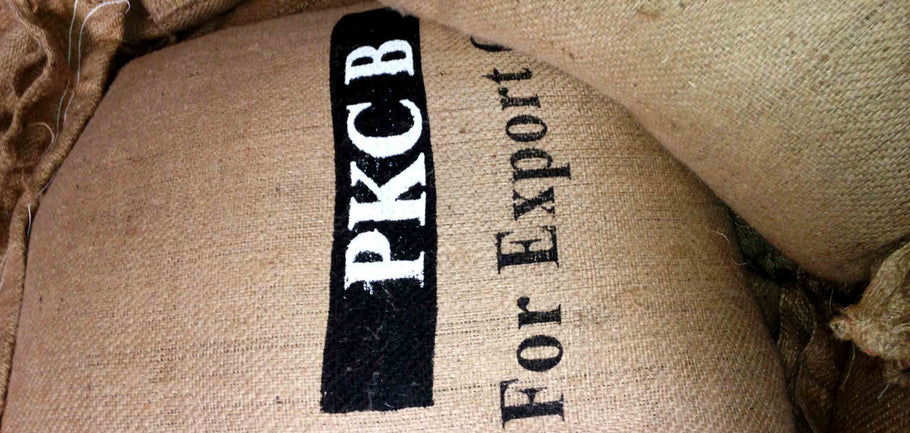
1. Coffee in burlap sacks against the back wall with Peace Kawomera (PKC) lettering
2. A concrete floor with someone sleeping on a mat
3. A hand operated machine that is used to remove parchment from beans that have dried in the sun after the cherry pulp has been removed
4. White open sacks of coffee in parchmentThis picture uncovered a different set of issues. Where did the 250 burlap sacks come from and where were they going? They were ready for export while our coffee was ready to be taken to the mill in town to be “readied for export.”
This was the warehouse under the offices where we met the Board for discussion of the issues we came to resolve (late shipment, blending of coffees, verification of the sources of the coffee). As an aside, the PKC offices were in a building that was only half completed. In 2010, USAID funded the building of a small central coffee washing station. Thanksgiving Coffee’s rebates to the cooperative provided their in-kind contribution to the Grant. Unfortunately, there was embezzlement of funds by the coop’s GM who ran off with funds, and the Founder of the Coop was removed from the Board. USAID withdrew its remaining funds – and the building remains built but without a completed interior (no doors on offices , no paint on walls, No tables or chairs) and remains a shabby edifice that one would find hard to be proud of.
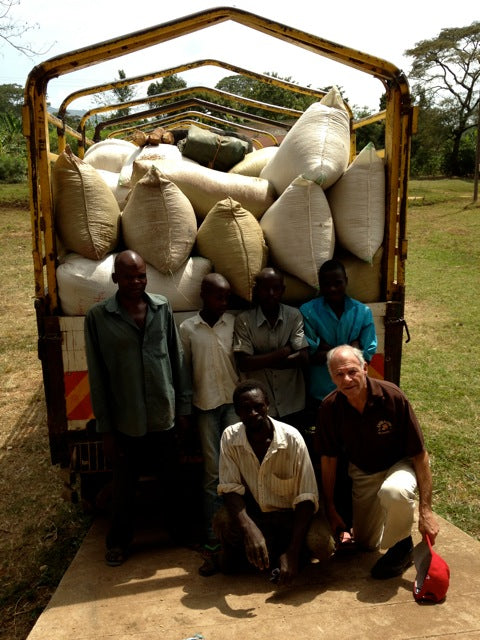 Parchment coffee is not green coffee. Parchment has to be milled off of the green beans so the green beans can be graded for percentage of defects. (broken beans, insect eaten beans, unripe beans, black beans, sticks, pebbles etc). Quality is related to the number of defects contained. Gumutindo, the secondary coop that is made up of 15 primary cooperatives of which PKC is but one member, accepts up to 7% defects. Anything over that needs to be sorted and picked out of the delivery to get the percentage down to 4%. If a coop delivers parchment coffee and there are more then 4% defects, they are deducted .02 cents per pound for each percent over 4%. The coffee in the open sacks had been delivered to the mill and tested, and showed 12% defects. That coffee had been rejected by the mill on our behalf – twelve pounds of defects per hundred makes for a very rough tasting coffee.
So, the sacks were brought back to the PKC warehouse to await my arrival – perhaps they thought I would have some “pull” at the Mill to get the coffee through. This was not exactly the way the problem was presented to me by the PKC management. They pointed fingers and said they were being picked on and that was why they wanted me, their buyer, to front for them at the mill. I thought this sounded legitimate, so I went to the GM at Gumutindo that afternoon to plead their case.

Willington, the GM of Gumutindo who has visited me in California, offered to send his truck to pick up the parchment coffee and re-test it in front of the PKC Board. That way, they could see for themselves just what the defect percentage was in the batch of coffee slated for Thanksgiving Coffee Company from their 2013 crop. But what about the other 250 sacks along that back wall? Where did that come from and how did it pass defect inspection? And where was it going? Who had produced it, who had sold it? Who had purchased it and who had financed it? This was on my mind as we hit the road to Gumutindo’s dry mill, and it would play an important role in the days to come.
We arrived at the dry mill (Gumutindo) that afternoon with the Board members of the cooperative to witness the grading process. It’s a simple process – first, a long pointed metal tube is thrust into a sack of parchment coffee and withdrawn filled with a sample from that sack. This is repeated on another ten sacks, each providing a small sample (about a half pound). The multiple samples are aggregated into a single sample from which 250 grams are taken and placed in a moisture meter.
The sample must come in under 13% moisture. Then, 100 grams are put through a hand crank parchment removal device and the green beans are then winnowed to remove dust and small pieces of parchment. The beans are then clean, and ready to be inspected for defects, which are sorted out by hand and eye inspection. There was an air of anxiety as the head sorter picked at the 100 gram sample.The defects are placed in a tray for all to see and agree on. Then they are weighed. This sample came out 9%. Again, too high for their Dry Mill to accept. Now there was a problem. I don’t want nine pounds of defects in every 100 pounds of coffee. There is no way I could make that coffee taste good enough to sell. The coop had to make a decision. They could pay the woman sorters to remove enough defects to get the coffee down to 7% or they could haul the coffee back to their warehouse 20 Kilometers to the north and sort out the defects themselves. Otherwise they would have to negotiate with the woman on a price for sorting out 2% from 30,000 lbs of coffee (600 pounds of defects).
At Gumutindo, the sorters are independent contractors. They sit under a giant shade tree at the mill and spend their days picking out defects, damaged bean by damaged bean. Unlike the sorters in Central and South America who sit at a conveyor belt that carries an endless stream of coffee beans past silent, sitting women who pick passing defective beans out of the rapids, these woman socialize all day and pick at their own pace. A much more civilized way to do tedious work.
The coop board members voted to hire the sorters and sent a member of the Board to the tree to negotiate a price for the sorting. About 300 feet from the defect assessment station the woman sat and sorted, each with their own sack to clean, knowing just how many pounds were needed to be culled from each sack to get it into an acceptable range.So now we had the 2014 crop due to be shipped to the US and arrive in May, being in the last phase before being put on a truck to travel to Mombasa where it will head south past Madagascar and round the Cape of Good Hope at the tip of South Africa and head across the Atlantic to The Panama Canal and up the west side of Central America toward its destination, The Port of Oakland. With 2013 crop and its problems behind it, I turned back to solve the mystery of the 250 sacks that were unaccounted for, with 17 screen and zero defects. What was their story?
To be continued...
-PaulA Trip to Africa (series archive)
Day 2 – Dancing, Mango Trees & the Dry Mill
Day 4 – Transparency, Trust & Relationships
Day 5 - Coffee Quality & A New Mystery
Day 6 – The Mystery Coffee’s Story
Day 8 - Making the New Transparency Work
A Trip to Africa: Day 5 - Coffee Quality & A New Mystery
read more -
![A Trip to Africa: Day 4 - Transparency, Trust & Relationships]()
A Trip to Africa: Day 4 - Transparency, Trust & Relationships
In January 2014, CEO & Co-Founder Paul Katzeff traveled to Africa to meet with two of our producer cooperatives. In this blog series, Paul shares his experience in Uganda and Rwanda.
When we left Jinja, we left with a deep satisfaction, having met some really serious people who were in the beginnings of something great. Two hundred elders were one day away from receiving a “Certificate of Completion” for the nine month course in Asset Based Community Economic Development offered by The Communities of SHALOM in collaboration with Drew University. This 3 credit course will give them the tools they need to enter the 21st century global trading environment and may be the only educational accomplishment many of them obtain (The certificate will be of parchment suitable for framing). I can see it now, hanging on a wood slab on a simple brick wall, inside a 12’x12′ square room with a red dirt floor, the only adornment to be found on any of the walls in the home of that proud community leader (and Organic Robusta coffee grower)
Nick and I felt that our trip had an auspicious beginning. We had a two pound sample of what looked to be a beautifully prepared Organic Robusta which we hoped to “cup” when we got to Mbale, and we had a mutually agreed-to trading relationship started if the coffee proved to be of good quality. It was not my primary purpose to search for another cooperative to work with, especially a coop that had never sold a pound of coffee before, but I use about 75,000 pounds of Robusta each year in our very popular, high caffeine coffee “Pony Express” which I now buy from Importers.

At Thanksgiving Coffee go to great effort to make sure we know the farmers we buy from and work with them directly. It is essential to our buying plan that the price farmers receive is high enough that they WANT to continue growing coffee. We want the farmer to love their trees because those trees are providing food, clothing, shelter, health care and education for their family and community. Trees that are loved produce better coffee, they are no different than tomato plants or marijuana plants: care for them, love them, and they will respond. That is the key to sourcing great coffee and sustaining the farmers’ efforts. Quality of life and quality of coffee go hand in hand.
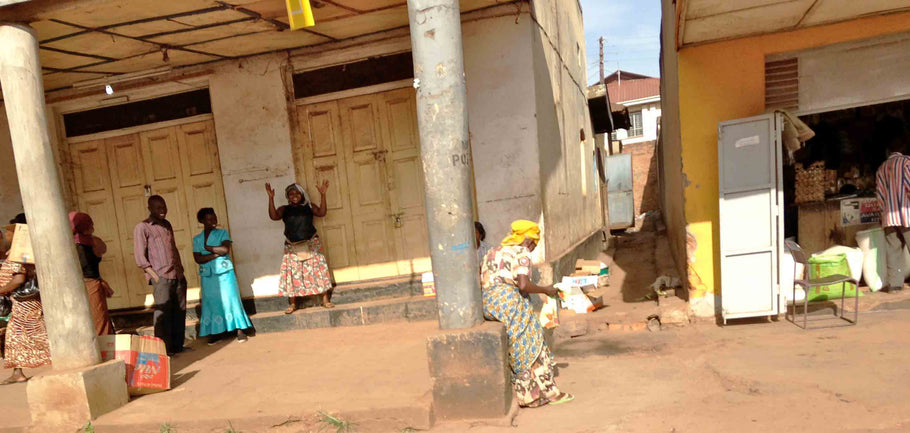
The road from Jinja to Mbale was red clay – dry and dusty. It’s the same material that most buildings are made from. A great and endless building material. This photo is rich in information. A dirt highway comes to a paved road with electricity poles and wires, a billboard advertising a soda of some kind, two motorcycles, people walking and a truck loaded with hand-sawed slab lumber driving to market. The trees are semi arid in their type, not at all tropical. In this dry, dusty Ugandan moment where the paved road began, I started to ready myself for the work ahead, the major reason for my 23 hour trip to the other side of the world – Uganda is 11 hours ahead of California time. Paved roads mean you are getting close to something!
At a gas station close to Mbale we came upon this sweet fruit vendor. We ate some bananas for lunch, something I don’t think of doing in the USA. Bananas in the tropics are like candy – and you look upon them as safe energy food. I thought I was taking a still shot but the video was on and I was lucky to get her little hip rotation presentation of her wares and that wonderful smile as it formed. She made me feel special in a male/female kind of way. I felt that she actually saw me more deeply then I could ever see her.
Here you see the way they do building in Uganda. They are, surprisingly, not artisan bricklayers – they just are bricklayers. I could see holes in the backyard where the bricks came from: you rarely see truck loads of bricks being transported to building sites because the bricks are made on location.
I went to Uganda to visit the Interfaith Cooperative of Jews, Christians and Muslims called Mirembe Kawomera. This cooperative has an incredible story – and Thanksgiving Coffee Company became the story teller for this miraculous group. We have purchased their entire coffee crop each year since 2004, and their coffee has been Certified Fair Trade and Organic the entire time. We market this coffee to faith-based groups, Churches, Synagogues, Mosques and to people who believe in and work for Interfaith healing in a troubled world.

This cooperative presents, perhaps the greatest coffee story ever told, and we have seen our efforts to promote this cooperative bring a modicum of fame (Oprah’s O Magazine) and recognition (Tufts University Jean Mayer Award). We sell the coffee to over 200 religous groups and congregations nationwide and our supply of green beans was running out when I left for Uganda. The supply was running out because the 2012 crop, which was slated to be shipped December 2012 and to arrive in Oakland in May 2013, was eight months late. I went to Mbale to find out why.
I had some clues before I left:
- The contract required that all the coffee be from the central washing station.
- In a Skype call to the Mirembe Kawomera Coop (PKC) manager ard the full Board back in October 1013, I asked what was causing the delay and I was told that they could only produce 110 sacks that they brought through their washing station.
Because our contract was for 250 sacks (37,500 pounds purchased at $3.05/pound), they did not know what to do and were instructed by our Importer (in the USA) to blend in other Ugandan coffees with the washing station coffees to fill the container – and ship it to Thanksgiving Coffee Company for sale as PKC washing station coffee. This presented a problem of certifiable authenticity of the product Thanksgiving Coffee presents to our customers.
The system of authenticity had broken down and I was there to see if I could verify that 110 sacks were actually run through the central PKC washing station. I needed to verify that each farmer’s delivery was recorded with their name, amount paid and farm location – and that all of this was recorded in the Cooperative’s records for the Fair Trade and Organic Certifiers to verify through their own field trips to farms.
This was a serious effort on all our parts to get back on track. We all knew that the transparency issue is essential to the trust we use as a basis for working together. Similarly, our customers depend on trusting that what they wish to support is what they are buying – that their purchases are going toward the economic development of a community of courageous people who believed that by coming together in an interfaith coalition coffee cooperative, they could better their personal lives, and their community life as well.
Here’s a video clip from the first meeting to discuss our mission. I asked each member of the Board to help me remember each one of them when I got home because I was not good remembering names and putting them with faces.
To be continued...
-PaulA Trip to Africa (series archive)
Day 2 – Dancing, Mango Trees & the Dry Mill
Day 4 – Transparency, Trust & Relationships
Day 5 - Coffee Quality & A New Mystery
Day 6 – The Mystery Coffee’s Story
Day 8 - Making the New Transparency Work
A Trip to Africa: Day 4 - Transparency, Trust & Relationships
read more -
![A Trip to Africa: Day 3 – On the Road]()
A Trip to Africa: Day 3 – On the Road
In January 2014, CEO & Co-Founder Paul Katzeff traveled to Africa to meet with two of our producer cooperatives. In this blog series, Paul shares his experience in Uganda and Rwanda.
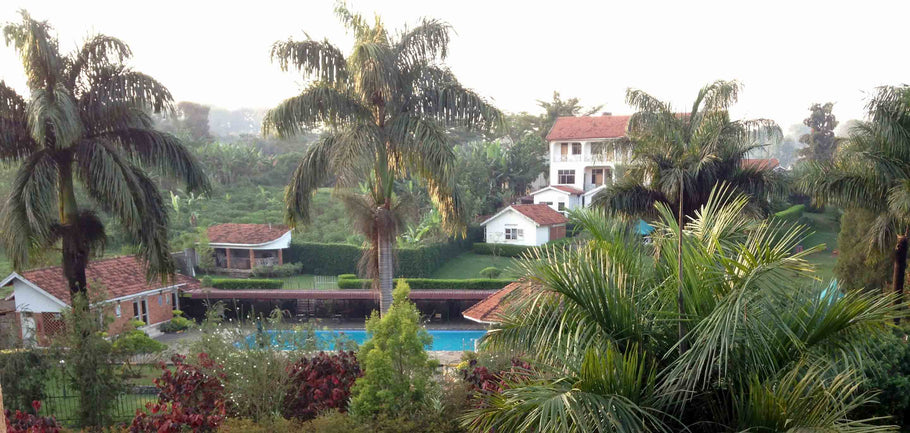
After two days in Jinja in the poor countryside we would return to our hotel for a touch of our comfortable western style life. Hot showers, fruit sliced properly, Gin and Tonic: Uganda was a British Colony back 60 years ago. In the background you can see the Colonial Style architecture beyond the pool. The Hotel manager who came to greet us at our arrival was in a suit and tie, very British in accent. He was from South Africa and considered his "posting" here at the hotel as a purgatory and informed us he was leaving "his post" in two weeks to return to Johannesburg to resume his life. Driving to Mbale, Uganda In this photo, we are approaching the coffee growing region of Mt. Elgon, just outside of Mbale.

In the distance you can see the mountain. It rises up rather spectacularly as you approach it.

Here is my traveling partner, Mr. Nicholas Hoskyns.
Nick is a Brit who lives in Nicaragua. He is an expert in many fields and specifically cooperative management and business practices. He is the President of a British Charity called ETICO, an acronym for "Ethical Trading Company." Being British I thought it appropriate to photograph him in a tea field! In his hand he is holding "two leafs and a bud", the most delicate of the new growth and most flavorful. By this time, I was getting excited to visit the Mirembe Kawomera Fair Trade Cooperative. This is a cooperative that consists of Jews, Christians and Muslims who came together to work in a coffee cooperative system to obtain the benefits of selling into the Fair Trade and Organic specialty coffee export market. It is the only such Interfaith cooperative in the world and their story has been documented in a 60 minute documentary called "Delicious Peace Grows in a Ugandan Coffee Bean." The cooperative has been awarded many honors. Thanksgiving Coffee Company has promoted their coffee under the Mirembe Kawomera (Delicious Peace) label since 2004 and promises that only the coffee that their members grow is found in the packages and that each package sold adds $0.25 cents to a fund that we send to them each year to be their "in kind" contribution when they seek grants for projects to improve their community. To date we have sent $95,000 and they have built a central coffee washing station with grants from USAID, a climate change program with a tree planting project and in the works for this year will be an expansion of their central washing station and a cupping lab for tasting their coffees of each farmer prior to export so they all can taste the fruits of their individual labor on their farms. Last year, we had some hang-ups in the coffee supply chain. Mirembe Kawomera was unable to produce a full container of coffee for us and the shipment was eight months late. Orders were coming in and we could not substitute any other coffee for their package. What was going on? Nick came with me to examine the books and help with the supply chain logistics.

What's going on in this photo? The facade on the store is a Persian mosaic - Muslim occupants I would guess. I probably could have gotten off here and settled into a simple life of walking two miles to get the day's water from a well that ten kids were filling five gallon plastic containers for their families (40 pounds) and carrying it back many miles instead of being in school or playing little League baseball. Actually Uganda is soccer crazy. They seem to favor Arsenal in the Upper leagues of Europe. Tomorrow we will visit the Mirembe Kawomera facilities to meet with their Board of directors and talk about their issues and my issues.
To be continued...
-PaulA Trip to Africa (series archive)
Day 2 – Dancing, Mango Trees & the Dry Mill
Day 4 – Transparency, Trust & Relationships
Day 5 - Coffee Quality & A New Mystery
Day 6 – The Mystery Coffee’s Story
Day 8 - Making the New Transparency Work
A Trip to Africa: Day 3 – On the Road
read more -
![A Trip to Africa: Day 2 – Dancing, Mango Trees & The Dry Mill]()

A Trip to Africa: Day 2 – Dancing, Mango Trees & The Dry Mill
In January 2014, CEO & Co-Founder Paul Katzeff traveled to Africa to meet with two of our producer cooperatives. In this blog series, Paul shares his experience in Uganda and Rwanda.
Our first day in Uganda was a real experience. The farmers met under a giant Mango tree that had just produced over 1,000 pounds of ripe mangoes and was beginning to flower for next year's fruit. These trees grow wild and can be found everywhere. In the shade of the tree people danced and celebrated. The heart of Rock and roll and the Blues came from these people - I could feel the rhythms vibrate my body and I was moved to dance ... but just couldn't get in there with them. I felt the beat but didn't feel I had the moves. The kid who was drumming was good! (see below)

Back on the road north to our primary Destination, The city of Mbale, the home of Mirembe Kawamera Cooperative. This is the famous interfaith cooperative of Jews, Christians and Muslims working together in a small outlying mountain village in the shadow of Mt. Elgon in the northeastern part of Uganda. This photo shows a typical roadside crossroad. Hard to say what is going on there but in the background is another Giant Mango tree and to the left down the road a couple of hundred feet are banana trees.

This homestead along the road had solar electric panels right in front of their house.

The two hour trip from Jinja to Mbale was filled with a life force so different, visually. These pictures show how western culture mixes with people who have too little but need the same things we need. Food, clothing, shelter and commerce. This little store sells what is needed, not what is wanted. The difference narrows

The selections down to what is available to sell. Carrying Coffee Sacks in Uganda This was our first destination in Mbale, The "dry mill" where our coffee is readied for export after being received from the primary cooperative in the mountains. This is where the coffee is graded (sorted) for defects and the parchment is milled off of the coffee and the burlap sacks are filled with 152 pounds of green coffee beans. Yes, those guys are carrying 150 lbs of coffee.
To be continued...
-PaulA Trip to Africa (series archive)
Day 2 – Dancing, Mango Trees & the Dry Mill
Day 4 – Transparency, Trust & Relationships
Day 5 - Coffee Quality & A New Mystery
Day 6 – The Mystery Coffee’s Story
A Trip to Africa: Day 2 – Dancing, Mango Trees & The Dry Mill
read more -
![A Trip to Africa: Day 1 - Arriving In Uganda]()
A Trip to Africa: Day 1 - Arriving In Uganda
In January 2014, CEO & Co-Founder Paul Katzeff traveled to Africa to meet with two of our producer cooperatives. In this blog series, Paul shares his experience in Uganda and Rwanda.
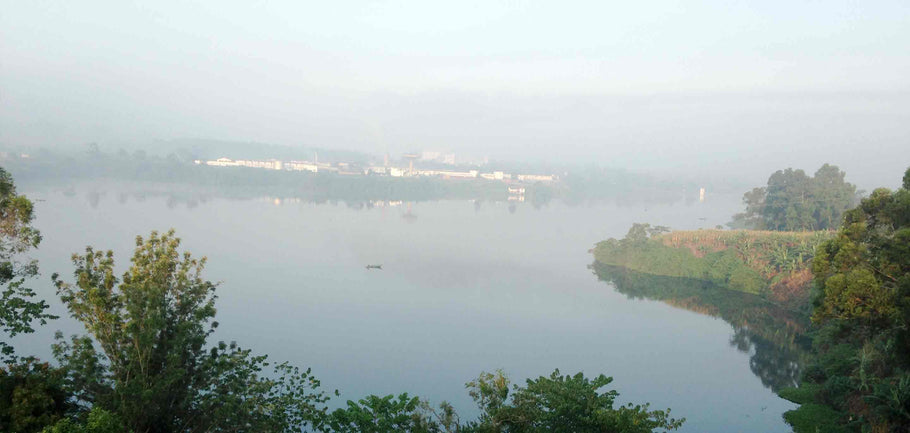
We arrived in Uganda (Entebbe Airport) at midnight. In two hours we were in Jinja to visit a coffee cooperative that is producing organic Robusta coffee. This might be the only organic Robusta in the world - so I was eager to meet the farmers. Our hosts and drivers were from Communities of Shalom, a US-based interfaith social justice organization based at Drew University that has been doing Economic Development work at the cooperative for the past nine months. They work to build community strength and empower coffee farmers to run their cooperatives effectively - so that they can benefit farmers and their families. We awoke the following morning to see Lake Victoria from our hotel window. Lake Victoria is the headwaters to the Nile. I felt the water, just as I did the Mississippi River 50 years ago when I first crossed it. It felt good!

Chairperson Fredrick Kibalama and CEO of Thanksgiving Coffee , Paul Katzeff
On the Coop chairman's farm we posed for a picture. Note the large Mango tree in the background and the Banana tree under it to the left. The weather was mild, about 80 degrees, and the sun was beginning to warm the top of my head. Fredrick's farm was about as self-sufficient food wise as one would enjoy here in the USA.

Here you can see the coffee trees being shaded by the Banana trees and the large trunk in the background of a very tall Mango tree shading all the undergrowth, keeping the ground cool and the moisture in this soil. I loved the Sign that reads "Organic Power Plant," a broad-based double-meaning set of words. One cow's manure will fertilize 1,000 coffee trees per year and the urine tea provides nitrogen. No waste here. Plus, milk and cheese for the family. Organic Power Plant indeed!

Robusta coffee is processed using what is called "The Dry Method." The cherries put out in the sun to dry. Fredrick had some recent pickings drying on a plastic mat when we arrived and about another 25 pounds of ripe cherries ready for sun drying with the cherry pulp still on the cherry. You can see how they turn black when they dry. In this photo I am smelling the de-hulled and finished coffee that was taken from the paper bag next to the sack of cherries. The beans were clean and sweet smelling and foretold, I hope, a bright future in the cup.
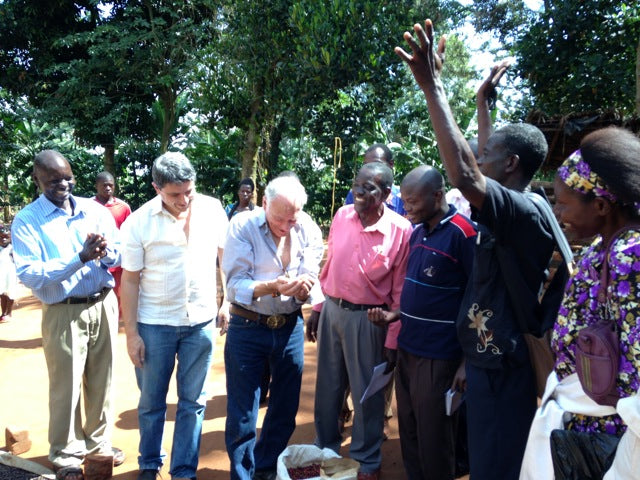
When I congratulated the farmers on a job well done, Moses (the Community's political leader) and the farmers were happy campers. This is because last year, the sample brought back to me was dirty and moldy, so I rejected it and sent instructions for them to follow for the next harvest season. This time, I was there to buy their coffee if it was clean and smelled sweet. Robusta is not a coffee variety that is noted for its flavor but it is useful in many other ways (body in Espresso blends for one). I agreed to purchase the coffee and I became the coop's first international buyer.

In this photo, my associate and Board member of Thanksgiving Coffee who is an expert on coffee supply chain infrastructure (how to get it from there to here), was explaining something we found by pure luck. It was, as I explained to the farmers, perfect timing that we arrived to see a potential disaster averted. Nick was showing them the problem. On the mat in front of him, the black drying cherries had a white mold softly covering the skins. The cherries were allowed to dry too slowly. They were probably not covered at night and the dew promoted the mold growth.
But, as luck would have it, there was a fresher lot to the right on the same mat and it was mold free. The lessons were there to be drilled home. All it took was a smell test and everyone knew what was needed, especially when I told them that the moldy smell was just a smell, but could they imagine drinking a coffee that tasted moldy ? The batch was separated and the potential for the coop coffees improved...if word gets out to all the farmers in the Coop.
To be continued
-PaulA Trip to Africa (series archive)
Day 2 – Dancing, Mango Trees & the Dry Mill
Day 4 – Transparency, Trust & Relationships
Day 5 - Coffee Quality & A New Mystery
Day 6 – The Mystery Coffee’s Story
A Trip to Africa: Day 1 - Arriving In Uganda
read more -
![A Trip to Africa: Intro - I'm going to Africa]()

Intro: I'm Going to Africa
On January 12, I depart my comfortable home on the North Coast of California to visit coffee Farmers and Cooperatives in Rwanda and Uganda. I haven’t visited them on their home turf for almost a decade. Over the last several years Ben Corey Moran, our former Director of Coffee, deepened our relationships with Cooperative leaders and farmers in Africa. It is my intention that this visit will strengthen those ties.

I’ll be traveling with Nicholas Hoskyns of Etico, an import/export company that has imported our Nicaraguan coffees for the past two years. In 2004 he accompanied me to Rwanda on a USAID consulting job to help The Cooperative Coffee Sector plan its “cupping lab” construction project for cooperatives. He has a vast knowledge of Cooperatives and their organizational structures.The trip’s focus will be on collaboration: How can our relationship improve quality of life for both coffee farmers and coffee roasters? I believe that quality of life and quality of coffee go hand in hand. There has to be opportunity for a better life in all parts of the coffee trading chain, from the farm to the cup. It is the farmers’ love of their trees that makes good coffee great. Back here in Ft. Bragg , California, it is our pride in what we create for the coffee lover that makes great coffee remain great.
There are some sticky issues that need attention, which have made this trip necessary. Primarily, about crop financing, shipment dates, and creating a system of transparency that demystifies the transfer of money from Thanksgiving Coffee to the individual farmers.
I want to have a first person experience in discovery and learning. And I want to share this 10 day adventure with you. I use the word “adventure” with a certain amount of respect for its broad application. I am not “going on an adventure,” but I know it will be an adventure. What I wish for is the most uneventful yet spiritual adventure. No ceremonial high points and no high fives or WOW’S! I’m hoping for a low key visit with a slow easy gait, and a smile on my face when I return home.
To be continued…
-PaulA Trip to Africa (series archive)
Day 2 – Dancing, Mango Trees & the Dry Mill
Day 4 – Transparency, Trust & Relationships
Day 5 - Coffee Quality & A New Mystery
Day 6 – The Mystery Coffee’s Story
Day 8 - Making the New Transparency Work
A Trip to Africa: Intro - I'm going to Africa
read more


