

Our Blog
Part III: Caring for Your Coffee Tree
View BY :
The Beauty of Growing Coffee Trees in Your Home

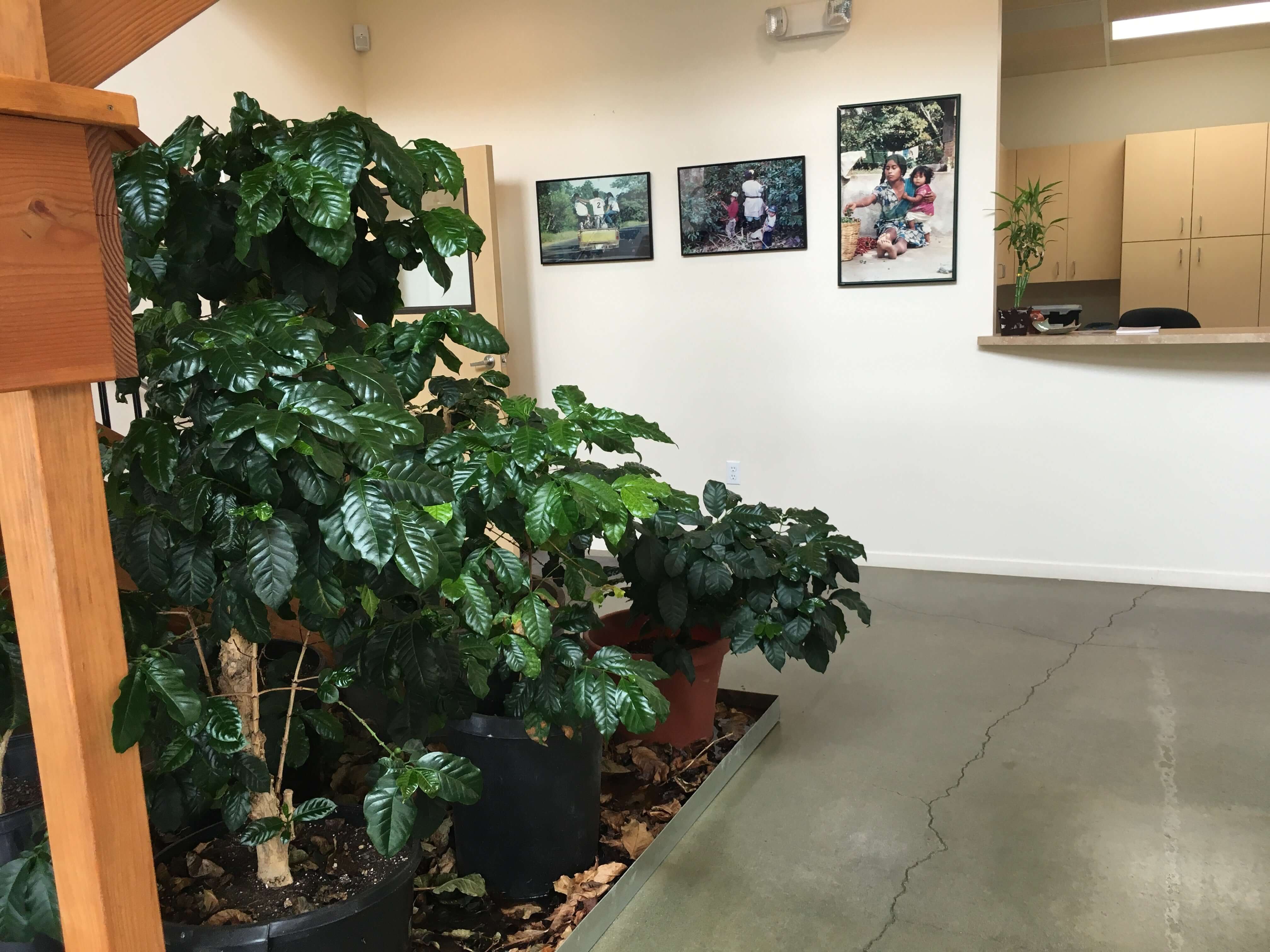
Coffee trees are remarkable for their ability to regenerate after severe pruning.
Severe pruning is hard on the psyche. You have taken care of your tree for 15 years and it has produced an amazing amount of enjoyment as it took you through its seasonal life cycles for 12 of those years. You are no Paul Bunyan with an anxious ax. You want to save trees, not chop them down. So you are about to break your own heart and you know it. You are, however, about to rejuvenate your tree and it will love you for your bravery. Sharp pruning shears are all that you need (and faith).

“The Cut” – May 4, 2016
On May 4th, 2016 the “cut” was made about 18” from the base of the tree; it broke my heart. That’s because I harvested 511 cherries from the tree, de-pulped them, soaked the seeds in a water-bath, dried them for a week on a window sill, and in the end had about 12 ounces of green beans. We invited the mayor of Fort Bragg, chefs, a winery owner, and our staff to a once in a lifetime “cupping.” We put the roasted beans on the cupping table with coffees from Central America and were pleasantly surprised when they received the highest praise for flavors we described as bright with hints of lemon, peanut butter, and dark chocolate.

27 Days Later – June 1, 2016
Note the small fresh leaves close to the trunk. This tree has plenty of root spore and therefore it is overpowered. It has stored its regenerative powers and now those roots have much less plant structure to support. It will put on a vigorous growth spurt over the next 6 months. Notice a new trunk beginning about 8” up the main trunk. We will watch it and hopefully 2 or 3 others will emerge from the lower trunk, proving the structure for the new tree.

48 Days After “The Cut” – June 21, 2016
The tree is beginning to fill in its remaining architecture with bright new leaves and a second trunk has emerged at about 10” from the base. We are on our way. There is nowhere to go but up and out.
Stay tuned for photos of its progress over the next 6 months.
Read The Full Series
Part I: The Beauty of Growing Coffee Trees in Your Home
Part II: All you Need to Know About Growing Coffee Trees At Home
Part III: Caring For Your Coffee Tree
Recommended Reading
Back to the Blog-
![A History of Fair Trade and Coffee Farmer Advocacy]()

Cups of Change
the promise behind A Just Cup
Paul Katzeff with children of the Nicaragua Coffee Farm 2001
"Be Our Voice"
Paul Katzeff recalls stepping off a plane in Nicaragua in 1985 and being greeted by Sandinistas carrying AK-47s. They were also campesinos, farmers trying to survive a civil war. They brought him into a room and asked him to carry their story home. He agreed.
That yes changed Thanksgiving Coffee. The people behind the harvest became part of what we meant by quality. Their request helped give us the words we still stand behind: Not Just a Cup, But a Just Cup™.
This October, Cups of Change follows that promise from Nicaragua to our roast room above Noyo Harbor, and into the wider coffee community. It is a story of what happened when a small Mendocino Coast roaster listened to farmers and began changing how it did business.
How Nicaragua Changed The Roast Room
Joan and Paul founded Thanksgiving Coffee in 1972 with a 25-pound roaster at the Mendocino Hotel. Freshly roasted coffee was finding its audience. We were learning our craft and building a business in the community that had welcomed us.
Original Menu and Roaster Illustration from Mendocino Hotel 1972
Café por la Paz, Coffee for Peace, gave our customers a deeper way to take part in our coffee journey. Our 1986 brochure shared how we gave a 25-cent contribution from each bag of coffee sold. The program sent rebates to UNAG, a Nicaraguan farmers’ organization supporting agrarian reform. Our 2016 retrospective shares how we distributed 500,000 educational brochures. Coffee was now a way to bring farmers’ struggles into American homes and give direct support back to their hard work.
We tell more of that history in our blog A Just Cup.
The promise to be the farmers voice was taking a practical form: a bag of coffee could carry information, raise funds, and invite a customer into a relationship with the people who grew it.
For the farmer organization’s perspective on this history, read “Daniel Núñez: The Farmers’ View,” a 1991 interview in Revista Envío, exploring farmers’ struggles for land, fair prices, and peace.
Changing what a coffee bag could tell you
Some changes began even before Nicaragua. Our packaging history records roast color on labels in 1972 and the use of Goglio valve bags in 1977. Freshness dates gave customers another useful fact about their coffee. These details helped people understand what they were buying and helped us deliver the flavor we worked so carefully to develop.
In 1992, our Harvest Line put farmers’ photographs on the packages. Customers could see a face behind the harvest. The grower’s work deserved a place beside the roaster’s name. Our early organic coffees and later commitment to shade-grown coffee also brought the health of the farming landscape into the conversation.
Harvest Line packages - Thanksgiving Coffee Company 1992.
Those choices helped turn a package into an invitation to pay attention. They connected the pleasure of drinking coffee with questions about who grew it, how it was cultivated, and how its value was shared. Independent roasters and producer organizations were building a wider movement toward fairer trade, and we were proud to work alongside them.
From one roaster to an industry conversation
A small roastery can have a voice beyond its harbor. Thanksgiving Coffee was a founding member of the Specialty Coffee Association of America (SCAA), and Paul was the association’s first president, serving three terms. In 2008, the SCAA honored him with a Lifetime Achievement Award for his extraordinary contributions.
In 1992, as president of the board, Paul created the SCAA Environment Committee, later renamed the Sustainability Committee. Its questions reached beyond the roast room. How could coffee businesses support the people growing their beans? What did the industry owe the forests, soil, and biodiversity that made those harvests possible?
Those questions became commitments. On October 10, 1997, the SCAA board unanimously adopted a sustainability policy that named biodiversity protection, respect for human rights, and prices that could support economic sustainability.
For us, this is part of becoming a movement maker: listening to farmers, bringing fellow roasters together, and helping turn concern into collective action. Paul’s leadership was one contribution to work carried forward by many people across the coffee community.
Explore this chapter of our history:
- A Just Cup: The story behind specialty coffee’s first environmental committee
- SCAA Sustainability Statement
- Quality revolutions, solidarity networks, and sustainability innovations: following Fair Trade coffee from Nicaragua to California
This is how a movement grows. People meet, disagree, organize, and change what their profession is willing to take responsibility for. We were one part of that work, alongside collaborators who carried it far beyond Mendocino.
Putting the tools of quality in farmers' hands
The promise also changed who gets to judge a coffee. From 2000–2001, Thanksgiving Coffee worked with USAID and Nicaraguan cooperatives on farmer-owned cupping labs. A lab made structured tasting possible at origin, and training taught growers to use the same tools and standards buyers use to assess their harvest.
For a producer, that knowledge supports experiments, improvements, and negotiations grounded in what the coffee actually is. UCA Miraflor and CECOCAFEN were among our cooperative partners. These farmers already knew their land deeply. The cupping tools gave them another way to show the value they create.
Explore the cupping lab story to meet the people and cooperatives behind this change. The ripple was practical: more knowledge at origin, better-informed conversations about value, and a stronger place for farmers in the story of specialty coffee.
Songbird Colombian carries the conversation forward
The questions behind our work with farmers, how coffee is grown and what a purchase can support, still guide us today. One example is our October feature coffee, Songbird Colombian, an organic, Smithsonian Bird Friendly certified dark roast with notes of toasted nut and dark chocolate and a smooth, lasting finish. Every package supports the programs of the American Birding Association.
Its story begins in Colombia’s Sierra Nevada de Santa Marta, where our Agroberlin farmer profile introduces Dario Delgado and his family’s La Cabaña farm. Coffee grows there beneath native shade trees, and our relationship with Agroberlin began in 2015. Bird Friendly certification requires organic production and verified habitat protections, so the trees overhead are part of the story, too.
Care still has to arrive as a delicious cup. That work happens every day in our roast room, where experience and close attention turn a farmer’s harvest into the coffee you brew. In 2017, Roast magazine named Thanksgiving Coffee its Macro Roaster of the Year. We’re grateful for that recognition, and for the growers whose coffee makes our craft possible.
The next ripple begins here
For more than fifty years, Thanksgiving Coffee has contributed time, energy, and coffee to community gatherings along the Mendocino Coast. Behind that history are neighbors setting up events, artists sharing their work, volunteers making things happen, and coffee being poured while people come together. We are part of this community, and it is part of us.
This October, we are contributing coffee to the Native Arts Expo and One People, One Fire October 16–18 in Mendocino, with Bee Bold Alliance helping share the invitation. These Indigenous-led gatherings offer a chance to listen to Native voices, meet artists, and support their work. We invite our neighbors to join us.
We want a regenerative future for Thanksgiving Coffee and the harbor we call home. We are exploring how food sovereignty, art, and community learning might grow alongside the work of roasting and our relationships with farmers. To carry those possibilities forward, this company needs a healthy business behind it. The next chapter depends on people continuing to choose our coffee.
If this work matters to you, choose Songbird Colombian, select a subscription if it fits your household, or introduce a friend to Thanksgiving Coffee.
Your order helps sustain the daily work and relationships behind this story. Then brew a little extra for this month’s Maple and Coffee Baked Pears. The cook deserves a cup, too.
“Be our voice” began with farmers asking to be heard. Cups of Change is an invitation to keep listening, and to let what we learn change what we do. Thank you for helping carry that promise forward.
Not Just a Cup, But a Just Cup™
Frequently Asked Questions
What was Thanksgiving Coffee’s Coffee for Peace project?
Coffee for Peace was a project supported by Thanksgiving Coffee in the 1980s that connected Nicaraguan coffee producers with consumers in the United States and Canada. Coffee sales returned funds to Nicaragua’s farmers’ organization, UNAG, to support farming communities.
What does “Not Just a Cup, But a Just Cup” mean?
Thanksgiving Coffee’s motto connects great coffee with responsibility to the people who grow it. Co-founder Paul Katzeff adopted the phrase after visiting Nicaragua in 1985, when witnessing farmers’ living conditions changed his understanding of what a good cup of coffee should represent.
How did Thanksgiving Coffee support coffee farmers in Nicaragua?
Thanksgiving Coffee purchased Nicaraguan coffee, advocated for producers, and supported the Coffee for Peace project. Later, the company helped nine Nicaraguan cooperatives establish farmer-owned cupping laboratories and trained producers to evaluate their own coffee.
How can coffee cupping help farmers negotiate better prices?
Cupping is a standardized way to evaluate coffee’s aroma, flavor, and quality. Access to cupping equipment and training helps farmers understand and document their harvest’s value, giving them stronger information for discussions with buyers. Quality knowledge supports negotiation, although it does not guarantee fair compensation.
What is Smithsonian Bird Friendly coffee?
Smithsonian Bird Friendly® coffee meets certification requirements for organic farming and wildlife habitat protection. The standards protect tree cover and biodiversity on coffee farms, helping conserve habitat for migratory and resident birds.
About the Author
Lavender Grace Kent, Head of Brand Narrative & Culture
Lavender Grace documents Thanksgiving Coffee’s history, producer relationships, environmental commitments, and continuing work at the intersection of coffee, culture, and biodiversity.
Stay in touch - we like to stay connected
A History of Fair Trade and Coffee Farmer Advocacy
read more


Cups of Change
the promise behind A Just Cup
Paul Katzeff with children of the Nicaragua Coffee Farm 2001
"Be Our Voice"
Paul Katzeff recalls stepping off a plane in Nicaragua in 1985 and being greeted by Sandinistas carrying AK-47s. They were also campesinos, farmers trying to survive a civil war. They brought him into a room and asked him to carry their story home. He agreed.
That yes changed Thanksgiving Coffee. The people behind the harvest became part of what we meant by quality. Their request helped give us the words we still stand behind: Not Just a Cup, But a Just Cup™.
This October, Cups of Change follows that promise from Nicaragua to our roast room above Noyo Harbor, and into the wider coffee community. It is a story of what happened when a small Mendocino Coast roaster listened to farmers and began changing how it did business.
How Nicaragua Changed The Roast Room
Joan and Paul founded Thanksgiving Coffee in 1972 with a 25-pound roaster at the Mendocino Hotel. Freshly roasted coffee was finding its audience. We were learning our craft and building a business in the community that had welcomed us.
Original Menu and Roaster Illustration from Mendocino Hotel 1972
Café por la Paz, Coffee for Peace, gave our customers a deeper way to take part in our coffee journey. Our 1986 brochure shared how we gave a 25-cent contribution from each bag of coffee sold. The program sent rebates to UNAG, a Nicaraguan farmers’ organization supporting agrarian reform. Our 2016 retrospective shares how we distributed 500,000 educational brochures. Coffee was now a way to bring farmers’ struggles into American homes and give direct support back to their hard work.
We tell more of that history in our blog A Just Cup.
The promise to be the farmers voice was taking a practical form: a bag of coffee could carry information, raise funds, and invite a customer into a relationship with the people who grew it.
For the farmer organization’s perspective on this history, read “Daniel Núñez: The Farmers’ View,” a 1991 interview in Revista Envío, exploring farmers’ struggles for land, fair prices, and peace.
Changing what a coffee bag could tell you
Some changes began even before Nicaragua. Our packaging history records roast color on labels in 1972 and the use of Goglio valve bags in 1977. Freshness dates gave customers another useful fact about their coffee. These details helped people understand what they were buying and helped us deliver the flavor we worked so carefully to develop.
In 1992, our Harvest Line put farmers’ photographs on the packages. Customers could see a face behind the harvest. The grower’s work deserved a place beside the roaster’s name. Our early organic coffees and later commitment to shade-grown coffee also brought the health of the farming landscape into the conversation.
Harvest Line packages - Thanksgiving Coffee Company 1992.
Those choices helped turn a package into an invitation to pay attention. They connected the pleasure of drinking coffee with questions about who grew it, how it was cultivated, and how its value was shared. Independent roasters and producer organizations were building a wider movement toward fairer trade, and we were proud to work alongside them.
From one roaster to an industry conversation
A small roastery can have a voice beyond its harbor. Thanksgiving Coffee was a founding member of the Specialty Coffee Association of America (SCAA), and Paul was the association’s first president, serving three terms. In 2008, the SCAA honored him with a Lifetime Achievement Award for his extraordinary contributions.
In 1992, as president of the board, Paul created the SCAA Environment Committee, later renamed the Sustainability Committee. Its questions reached beyond the roast room. How could coffee businesses support the people growing their beans? What did the industry owe the forests, soil, and biodiversity that made those harvests possible?
Those questions became commitments. On October 10, 1997, the SCAA board unanimously adopted a sustainability policy that named biodiversity protection, respect for human rights, and prices that could support economic sustainability.
For us, this is part of becoming a movement maker: listening to farmers, bringing fellow roasters together, and helping turn concern into collective action. Paul’s leadership was one contribution to work carried forward by many people across the coffee community.
Explore this chapter of our history:
- A Just Cup: The story behind specialty coffee’s first environmental committee
- SCAA Sustainability Statement
- Quality revolutions, solidarity networks, and sustainability innovations: following Fair Trade coffee from Nicaragua to California
This is how a movement grows. People meet, disagree, organize, and change what their profession is willing to take responsibility for. We were one part of that work, alongside collaborators who carried it far beyond Mendocino.
Putting the tools of quality in farmers' hands
The promise also changed who gets to judge a coffee. From 2000–2001, Thanksgiving Coffee worked with USAID and Nicaraguan cooperatives on farmer-owned cupping labs. A lab made structured tasting possible at origin, and training taught growers to use the same tools and standards buyers use to assess their harvest.
For a producer, that knowledge supports experiments, improvements, and negotiations grounded in what the coffee actually is. UCA Miraflor and CECOCAFEN were among our cooperative partners. These farmers already knew their land deeply. The cupping tools gave them another way to show the value they create.
Explore the cupping lab story to meet the people and cooperatives behind this change. The ripple was practical: more knowledge at origin, better-informed conversations about value, and a stronger place for farmers in the story of specialty coffee.
Songbird Colombian carries the conversation forward
The questions behind our work with farmers, how coffee is grown and what a purchase can support, still guide us today. One example is our October feature coffee, Songbird Colombian, an organic, Smithsonian Bird Friendly certified dark roast with notes of toasted nut and dark chocolate and a smooth, lasting finish. Every package supports the programs of the American Birding Association.
Its story begins in Colombia’s Sierra Nevada de Santa Marta, where our Agroberlin farmer profile introduces Dario Delgado and his family’s La Cabaña farm. Coffee grows there beneath native shade trees, and our relationship with Agroberlin began in 2015. Bird Friendly certification requires organic production and verified habitat protections, so the trees overhead are part of the story, too.
Care still has to arrive as a delicious cup. That work happens every day in our roast room, where experience and close attention turn a farmer’s harvest into the coffee you brew. In 2017, Roast magazine named Thanksgiving Coffee its Macro Roaster of the Year. We’re grateful for that recognition, and for the growers whose coffee makes our craft possible.
The next ripple begins here
For more than fifty years, Thanksgiving Coffee has contributed time, energy, and coffee to community gatherings along the Mendocino Coast. Behind that history are neighbors setting up events, artists sharing their work, volunteers making things happen, and coffee being poured while people come together. We are part of this community, and it is part of us.
This October, we are contributing coffee to the Native Arts Expo and One People, One Fire October 16–18 in Mendocino, with Bee Bold Alliance helping share the invitation. These Indigenous-led gatherings offer a chance to listen to Native voices, meet artists, and support their work. We invite our neighbors to join us.
We want a regenerative future for Thanksgiving Coffee and the harbor we call home. We are exploring how food sovereignty, art, and community learning might grow alongside the work of roasting and our relationships with farmers. To carry those possibilities forward, this company needs a healthy business behind it. The next chapter depends on people continuing to choose our coffee.
If this work matters to you, choose Songbird Colombian, select a subscription if it fits your household, or introduce a friend to Thanksgiving Coffee.
Your order helps sustain the daily work and relationships behind this story. Then brew a little extra for this month’s Maple and Coffee Baked Pears. The cook deserves a cup, too.
“Be our voice” began with farmers asking to be heard. Cups of Change is an invitation to keep listening, and to let what we learn change what we do. Thank you for helping carry that promise forward.
Not Just a Cup, But a Just Cup™
Frequently Asked Questions
What was Thanksgiving Coffee’s Coffee for Peace project?
Coffee for Peace was a project supported by Thanksgiving Coffee in the 1980s that connected Nicaraguan coffee producers with consumers in the United States and Canada. Coffee sales returned funds to Nicaragua’s farmers’ organization, UNAG, to support farming communities.
What does “Not Just a Cup, But a Just Cup” mean?
Thanksgiving Coffee’s motto connects great coffee with responsibility to the people who grow it. Co-founder Paul Katzeff adopted the phrase after visiting Nicaragua in 1985, when witnessing farmers’ living conditions changed his understanding of what a good cup of coffee should represent.
How did Thanksgiving Coffee support coffee farmers in Nicaragua?
Thanksgiving Coffee purchased Nicaraguan coffee, advocated for producers, and supported the Coffee for Peace project. Later, the company helped nine Nicaraguan cooperatives establish farmer-owned cupping laboratories and trained producers to evaluate their own coffee.
How can coffee cupping help farmers negotiate better prices?
Cupping is a standardized way to evaluate coffee’s aroma, flavor, and quality. Access to cupping equipment and training helps farmers understand and document their harvest’s value, giving them stronger information for discussions with buyers. Quality knowledge supports negotiation, although it does not guarantee fair compensation.
What is Smithsonian Bird Friendly coffee?
Smithsonian Bird Friendly® coffee meets certification requirements for organic farming and wildlife habitat protection. The standards protect tree cover and biodiversity on coffee farms, helping conserve habitat for migratory and resident birds.
About the Author
Lavender Grace Kent, Head of Brand Narrative & Culture
Lavender Grace documents Thanksgiving Coffee’s history, producer relationships, environmental commitments, and continuing work at the intersection of coffee, culture, and biodiversity.
Stay in touch - we like to stay connected